Mar 3, 2012

Ancestors affect an American-African

My American-African Fiance

I'm now engaged to an American-African. Identity is a fickle thing, legal, social as well as individual.  That's how, after a long and lovely relationship I asked an American woman to marry me. A few short months later, I found myself engaged to a resident of Africa.

A lot changed, and nothing. After the painfully slow machinations of the government Erin got her Kenyan work permit.  That means, at this moment she is legally a resident of two different East African countries. I'm being facetious, but not entirely. Most African-Americans have a much smaller personal connection to Africa than Erin and I do.  At this point we've spent about 5% of our lives in Africa, but most African-Americans haven't stepped foot on the continent, nor have any of their ancestors in living memory.  At what point does ones physical location completely define ones continental or national affiliation?

For me, calling Erin an American-African is an amusing play on words, but for others these kinds of distinctions are vitally important.  I have a good white South African friend here who has told me a bit about his experiences.  During the crumbling of Apartheid in his country the white people had a lot of deplorable reasons to maintain their stranglehold, but they also had some legitimate concerns.  As the black majority began to flex their strength some advocated 'pushing the settlers to the sea.'  That's made for a powerful sentiment, but the reality of it was complicated.  Many parts of Africa had been heavily colonized well before North America was, with the first Dutch settlement established near Cape Town in 1647.  So these settlers had no other homeland since well over a century before my country got around to existing.  Even most black South Africans aren't 'native' depending on how one chooses to define it. The majority of the black populations ancestors moved in from other regions in the north about a 1000 years ago (which means it's closer to today than it is to the time of Jesus).  That's a long time, to be sure, but their people have only been in the region for less than three times the as long as the Europeans.
This fear of being 'pushed to the sea'  is why my friend said 'no white South African in his right mind would have voted for Mandela' (in 1994.) What happens to someone who doesn't have a right to exist anywhere on earth?  My friend quickly followed up his assertion by saying 'but then, Mandela's presidency was nothing short of a miracle.'  Balancing the opposing demands and rights of the whole population looked to be an impossible achievement, but one that has (with some hiccups) come into being.

I focused out South Africa only because it built to a crescendo within my life time, similar stories play out all over the continent.  I spent a a month living on a farm in Tanzania with three generations of farmers.  Although white, they easily identified themselves as Tanzanians in every way that matters.  Serious debates about who 'belongs' in a place is also an active issue in Kenya today.  During the colonial era tribes were pushed around as English settlers claimed vast swathes of land.  In many cases, entire tribes uprooted and moved to the ancestral land of other tribes.  Today on one side you have some angry that they have rights to land because their recent ancestors lived there.  On the other hand, todays residents also justifiably say they have rights to it because they have lived there for generations.

Identity and legal residence has been a vital issue for me too.  There was a time, while Erin and I were living in Tanzania, that I was an 'illegal.'  My visa took a long time to process through, and in the meantime the clock had run out on my three month 'Tourist Visa.'  Suddenly I had to live with the constant fear that if someone chose to make an issue out of it I could be deported on a moments notice.  Although I'm happy to still have an American passport, I didn't have as much to return to as my home, vocation, worldly goods and Erin were all in Tanzania.  If I was robbed, I would have had to seriously debate going to the police because the cost to me could have been far worse than what would happen to the actual criminal.
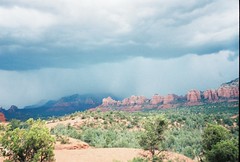
Sedona Arizona with Rein Teen Tours-4
Arizona, a beautiful place with ugly laws
Suddenly I had a lot more empathy for the illegal immigrants in America.  Although they always disgusted me, I now understand the horror of the recent anti-immigrant laws in Arizona and Alabama.  For me, at least I made the decision to come to Africa as an adult equipped to deal with the consequences.  For immigrant children who know nothing but life in America, and want to contribute, their nebulous status is not only dangerous and economically stupid, it's profoundly immoral too.  But it certainly gets worse, at least children born in the US are automatically granted citizenship, this is not true elsewhere.  In China and Switzerland, for example, you can have multiple generations of immigrants born in the country.

The point of this post is to show that, ultimately, our concepts of nationality are fundamentally arbitrary and based on the flawed rules of men not any higher morality. Congress could easily eliminate millions of criminals from the country by simply making their immigration legal. Those freshly minted Americans would have the prospects to add more to economy, serve in the military, pay into social security, and consider the police allies not enemies. It may seem outrageous today, but I see it as inevitable evolution.  Our modern ideas of nationality aren't new, the first evidence of something comprable to a passport was in the Persian empire in 450BC.

If we are indeed living in an era of globalization, it's tragically amusing that we're struggling with problems that exist largely because of concept of nationality established two and a half millenniums ago.

Feb 5, 2012

Identity infiltrates institutions illegally, involving the ICC

Erin, in front of my
favorite map of Kenya
A friend of mine recently complained that outside of Africa, most people would think of him as an African, not a Kenyan.   I teased him about that and said that when I go to another country I'm usually considered an American which really isn't a lot more specific.  Since July, and the birth of a new country, Africa has 54 independent countries while the Americas have a respectable 35.

I'll admit, that's kind of misleading.  When most people say 'American' they are referring to people from the USA much to the chagrin of Canadians, Argentineans and others.  But it's also misleading on the other end because an argument could be made that most Kenyans themselves don't see themselves as Kenyans.  Despite the well intentioned efforts of many, much of this country divides on tribal lines.  This concept of tribal identity makes huge difference here, and has arguably shaped post colonial history more than anything else.

Masai in Tanzania-51
 Masai, like these performing a traditional dance
are found throughout Kenya
Consider this, as the United States gears up for another 'most divisive presidential election' in modern history, the International Criminal Court just ruled that four of Kenyas most powerful people must stand trial for crimes against humanity committed during the last election.  Because of issues drawn on tribal lines in the 2007 election well over a 1,000 people were killed by angry mobs as they burned and looted cities.  High profile politicians (and many others) fanned the flames of violence, even as the then-candidate Obama pleaded with the people for calm.  This is history, but it's in no way the past, many of the same players are positioning themselves for this years election.

This puts things into perspective, doesn't it?  In the US, many are appalled that Newt Gingrich is running for president despite being the only Speaker of the US House in history to be reprimanded for 'Ethical Wrongdoing'.  In Kenya, two current top-tier presidential candidates have been indicted for crimes against humanity by the ICC.

Depending on how you divide it, there are 40 different tribes in Kenya but just a handful have a large enough population to dominate politically.  Since the countries independence whichever tribe had power brazenly shifted the priorities to help out 'their' people as opposed to Kenyans in general.  That applies roads, schools, government contracts as well as truly shocking levels of pure graft.  The book Our turn to Eat is a fascinating, adventurous, story that lays out a lot of this by telling the true and inspiring story of one mans fight against the status quo.
History is alive in Kenya


Before any take this post to be anti-Kenyan, it's definately not.  Nearly every country in the world has struggled with issues of corruption and some form tribalism.  When the US shook the yoke of colonialism and promised freedom and democracy, it shared little of either with any who weren't in the 'tribe' of Anglo-Saxon male property owners.  It took nearly a century before a literal civil war set free the underclass, and another century before the civil rights movement made it a legal reality.  Kenya is a young country, founded in 1963 in the place of a colony where tribal rivalries were created, encouraged and amplified.  Kenya has problems, but it is straining to make the same cultural shift  that the US is doing over two hundred years into a single human lifetime.

It was the best of times, it was the worst of times.  In many ways I'm very nervous about the elections this year, but I am in equal measure excited about it too.  Most Kenyans I speak with are not happy with how things work, despise the tribal political spoils system, and almost everyone is emphatic that things will be different this time around.  Almost two-thirds of the people approved a revolutionary new constitution in 2010 and in many ways Kenya is poised to quickly leap ahead as soon as it can put it's house in order.  One of the biggest indicators of what will happen is this coming presidential election through both how Kenya votes as well as their collective response to the results.

This is all complicated, scary, and profoundly uncertain.  This is one of those fleeting moments when humans get to decide whether their society should evolve.  It's fascinating, thrilling and I'm honored to be a witness.

Jan 29, 2012

Risk is the blade that shapes a life.

Mudds visit Mikumi-244 African wild buffalos are one of the most dangerous animals on the continent, they attack and kill hundreds of people each year. That's why, when we went to the gate of Hell, one of the most terrifying experiences of my life was when I came face to face with an angry bull while on a bicycle.

As we rented bikes to cruise around Hells Gate National Park we asked what animals we would see.  We were told ostriches, giraffes, warthogs, and buffalo.  'Wait, what was the last one!?  Aren't Buffalo dangerous?'  Yes they are, we were (not!) assured, but usually when they're in a herd they don't bother people.  It's actually single bulls that you need be afraid of.  If alone, it means they've lost a fight to dominate their herd and are likely angry, irritable, and anxious to prove that they can gore a living being to death.

Me, biking past a herd of one of
 Africa's most dangerous mammals
With that advice, Erin and I smiled, and started peddling towards the park.  It turns out, both of us are willing to take careful risks even if we don't know exactly what the rewards will be.  It's why we found each other, as well as why we find ourselves in Africa. A couple years ago, we had a little too much wine while in the Colorado mountains and somehow got the idea in our head 'Lets both apply to jobs in Africa, and if either gets one, we go.' A month later, Erin had a job offer for a little school in Tanzania.

Ernest Hemmingway, the author who popularized the idea of the African wildlife safari, once said, "Always do sober what you said you'd do drunk. That will teach you to keep your mouth shut."  So before we knew it we'd taken an 85% pay cut, rented the house and were on a long journey to Iringa.  I'd like to say it seemed like a good idea at the time, but it really didn't. The world economy was in the midst of crumbling into the deepest financial crisis since the great depression.  In our mid-30s, we both had given up stable and decent professional jobs each doing something we believed in a city we both love surrounded by friends and family.

Today Erin has a job developing the reading curriculum for thousands of underserved Kenyans. I've got a dream job, I'm starting a factory for a company that uses advanced technology to save lives, forests, and money via hyper efficient stoves.  We're engaged, living in a beautiful place in Kenya, and life is coming together surprisingly well.  After living frugally, except for many 'once in a lifetime' vacations, we're now actually saving money every month.  In hindsight, we couldn't have planned this epic journey any better but in the beginning we didn't have much of a plan.  We knew we were taking a big risk and had little but the hope that some unimagined rewards would make it worth it.

That's not unlike the risk of riding a bike through a buffalo infested landscape because we'd heard it was  nice place.  In that case the reward was a gorgeous day, stunning landscapes, and even a heated waterfall cascading down a cliff from a hot spring.  On our ride home sunburnt but smiling our legs were tired and after such a lovely day I was thinking more about dinner than the landscape.


That's why I didn't notice the single male Buffalo until were almost on top of him.  He noticed us though, and was getting visibly angry.  By accident, the road we were following curved along the side of tall sheer cliff, making it seem to the buffalo that we were trapping him.  He was not about to put up with that so started started snorting,  shaking his head and lumbering towards us.

In Africa in general, we're plunging ahead to see what life has to offer.  There, however, we turned around and pedalled back so fast that Lance Armstrong himself couldn't have kept up.

PS)  Speaking of risk, as I write this there are reports that a lion escaped from the national park and is loose somewhere in my neighborhood.  No wonder why I love it here.
Mudds visit Mikumi-600

Jan 22, 2012

Carefully constructing community

Micahs BDay Weekend-13
Birthday with friends
Community is fickle, hard to put your finger on, but vital.  To people like Erin and I, who've started afresh in a new country twice in the last two years, it's something we actively need to think about in a way that our more stable friends don't.  Everyone needs to carve out space in their life for others, but after you've been in the same place for years the idea of establishing traditions and meeting people is something is so so engrained in that's it's hard to examine it separately from everyday life.  If one is lucky it just happens organically.

Being the new kid on the block is not a new thing for either of us.  I changed school districts five times growing up, and moved to a new city for college during which I studied abroad four times.  After school I ended up living and working in three different states and as many countries each time with a new beginning.  As someone who has a natural tendency to withdraw, I've had varying levels of success in finding the community I crave.  I actually enjoy having a lot of time to myself, and have had many pleasant friday nights with the companionship of only a glass of wine and a good book.  However, when the days add into weeks, and then months, without meaningfully connecting with another person it creates a subtly growing depression.

Finding Erin, my partner in crime, helps a lot.  A community of two is a wonderful gift, and it has been on the strength of that that we've both been able to grow. Upon getting to Tanzania we, for the first time in our adult lives, gave up having our own personal space. Erin and I moved into a single room in an apartment with much younger strangers in a small town in an exotic land.  I'll never regret it, but sometimes we called it the 'pressure cooker,' because any small disagreement stewed because there was nowhere to go to cool off and get perspective.  Even taking a long walk wasn't an option after dark when the small threat of crime, and the bigger threat of wild dogs kept us inside.   The only solution was the same as when I sat in my lonely little studio apartment having just moved to Massachusetts: finding a broader community.

Mr MacAllen and Me
That's harder than it sounds, to say the least.  Fortunately, my father unwittingly taught me a lesson early in life that's served me well.  He too craves community, but with a stubborn proactivity that few share.  Shortly after moving our family to NY he wished he had some good friends that he could discuss books with.  So, he declared it.  He got permission from a local church to have a morning 'philosophy group' every Sunday and thereafter every week he dutifully went and made a pot of coffee.  He once let me know that it wasn't that easy, and there were many weeks early on where he was the only person there.  But, as Woody Allen once said '80% of anything is showing up,' so he ignored the lonely mornings and just kept at it.  Today that dynamic discussion group has been around for decades, outlasting him when he moved so far away he can't make it anymore.  But he hasn't stopped there, he brought the same stubbornness to his passion for playing music with people which has evolved over the years into a constantly changing kaleidoscope of bands, events, and now a regular folk music class at a local library.  Although a remarkable person, he isn't a professor of philosophy or an acclaimed musical prodigy that draws people in through his star power.

He does it by simply giving peoples need for community something to crystalize around.  Most humans crave community, and despite the economic boom in 'social media' it is something western society is not very good at meaningfully providing.  Most people don't recognize it, or know what to do about it, even as they suffer measurably from it's lack.  Obviously there are many worthwhile communities that do make the difference in many lives, but almost always their origin can be traced to a single person that willed it into being.  For it to be a success it must grow beyond it's founder to embrace the dynamic nature of it's members to a point where the founding is really just a small blip in it's history.    
Xmas Party 2010-2
We were thrilled when our Christmas party
 had more Tanzanians than expats

When Erin and moved to Iringa we had some great luck.  The three strangers we moved in with quickly became dear friends, and the small school Erin worked at had long been the hub of tight nit local community.  Our household wanted to do our part, so we declared our apartment the party house for faculty and friends.  We spent long happy hours preparing meals, procuring drinks, and begging people to come.  There were game nights, 'movie nights' done a laptop, and an American Thanksgiving (starring a couple small chickens, because turkey is hard to find).  A lot of people worked hard at the community and far more than our amazing wildlife safaris this made our time in Tanzania wonderful.

Kids at the Mesengai Crater
And then we moved north, to Nairobi Kenya and needed to start again.   We ended up in a neat little group called sports for change, which organizes outdoor activities in return for a small donation to a worth cause and started on a hike in the spectacular Mesengai crater.  Jumping forward a few months, moved to a smaller, and far less convenient, house because the new house was on a compound shared with a couple people we met on that hike.  We were lured to the outskirts of the vibrant city of Nairobi by the possibility of living in something more akin to cohousing.

Although it's taken some adjustment we love the gardens around the house, the bird filled trees, and reprieve from the crazy city.  We really like the people from neighboring houses, a motley crew from five different countries, but within a few weeks started missing the community that we'd moved here for because everyone was busy with their own lives.  So, Erin and I declared a weekly gathering.  Erin has long had the same philosophy on community as my father, with the added invaluable skill of being a very clever cook.  So, we invited whichever of our neighbors over for dinner and drinks one Monday.  Most couldn't make it, but some did, and by the end of the evening we let it be known that something like it was going to be a weekly tradition.  A lot more people showed up for the next one, this last week.  And by the end of the evening a couple people let it be known that next week the gathering should be at their place.

Success!

Jan 14, 2012

The Wedding-Industrial-Complex

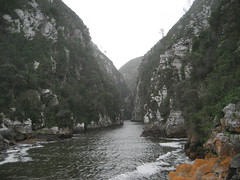
Storms River South Africa-125
Storms River, South Africa
South Africa has some of the oldest earth on earth.  Accordingly, it has some astonishing mineral reserves.  Since they started digging for it, it has been one (if not the) leading source of gold, platinum, diamonds (and much else).  This simple fact has altered a country, a race, the continent and the world for generations.  It is why South Africa has developed (and struggled) leaps and bounds beyond any other sub-saharan African country, and has since the late 1800s.  Today, the 18% of that countries economy that mining fuels keeps the country vibrant and growing even when the rest of the world economy struggles.  The simple fact that diamonds are an integral part of todays wedding ceremonies has much more to do with a guy named Cecil Rhodes than a naturally occurring stone.

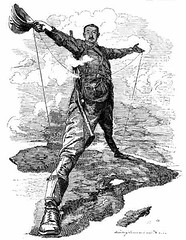
Cecil Rhodes Straddling Africa
Cecil Rhodes, and his plan
It's not only mineral riches, it's also marketing genius.  Diamonds are undeniably beautiful, but they aren't the rarest gem nor are they the hardest material.  They are an essential part of todays engagement and marriage rituals not because of something inherent, but because of a marketing campaign from the 1930s. But the story starts well before that, with Cecil Rhodes a colonial leader of a huge swathes of southern Africa.  He got his start in South Africa, and ultimately bought out the De Beers family farm and used that to secure the majority control of the worlds diamond output.  He was able to pull off this coup because his domain had the vast majority of the worlds diamonds.  He found that by carefully controlling the worlds supply he could set the price for a diamond to whatever he wanted.

After his death, the De Beers diamond company had a near worldwide monopoly of a gemstone that the world cared less and less about (in 1932 worldwide diamond sales were about $100,000.)  So, one day in the 1930s, they hired a firm called NW Ayers in the US to see what could be done.  They tried to rescue a fading concept, the 'diamond engagement ring' through clever product placement.  By 1979 the the worldwide diamond market was worth $2.1 Billion.  Specifics are difficult to find, but in 2005 the worlds output of diamonds were worth  $13.4 Billion.  More than 80% of American engagement rings have a diamond, at an average cost of about $3,200.

Cape Town South Africa-513
Me, breaking the (Apartheid) law
That campaign has had an unbelievable impact well beyond convincing people what stone engaged women need to wear.  It changed the economy and power base of sub saharan-Africa.  I won't exaggerate a point, but there is a reason people call them blood diamonds.  They've literally held up apartheid regimes, finance civil wars, and make a lot of beautiful people glitter.

That's only one part of what has become an astonishingly lucrative industry.  What I now like to call, 'the Wedding-Industrial-Complex' has taken DeBeers lead and used clever marketing to convince people that an average American couple needs to spend an average of over $26,000 on a single day.  There is nothing wrong with that, and I'm grateful that I've been invited to some truly remarkable weddings.  At the end of the day, it's a couples decision and whatever it becomes should be considered a generous gift to the friends and family that they invite.  But, when Erin and I talk about it, we found that even if we could afford it, it doesn't fit with our quirky priorities. We can think of other things we'd prefer to spend that kind of money on.  That could be a year-long international adventure travel honeymoon, clean drinking water for about a thousand people that don't have it, or sending 650 poor kids to the schools Erin is developing for a year.

Antananarivo-123
Erin in 'Tano
It's right about here that this whole story collapses into something a lot more personal.  People have every right to have any wedding they want, and I've long known that I'm peculiar because many of my priorities don't align with much of the society I grew up in.  What I find remarkable is, I've been fortunate enough to meet another person who shares my peculiar perspective. I love Erin, and have gotten to a point where I can't really imagine my life without her.  I wanted to ask her to marry me, but was stuck.  I don't want to be that guy so obsessed by history, politics and being manipulated by marketing that I can't let true emotions show.  Unfortunately, I didn't know if I had it in me to buy a diamond.

I asked Erin to marry me in Antananarivo, Madagascar.  I'd been thinking about it for a long time, but it wasn't until we were lost in a conversation about how we both wanted to live an 'exceptional life' that I realized that I didn't need or want to wait any more.  The next morning, we got up early and went shopping for rings in the jewelry district.  I started the day by asking her to choose any ring she wanted, quite literally, and without any caveats.  We looked at thousands of rings.  Most of them, obviously, were diamonds.

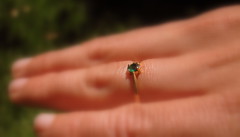
For her engagement ring, Erin chose an Emerald.
Erins Ring