Showing posts with label History. Show all posts

Mar 3, 2012

Ancestors affect an American-African

My American-African Fiance

I'm now engaged to an American-African. Identity is a fickle thing, legal, social as well as individual.  That's how, after a long and lovely relationship I asked an American woman to marry me. A few short months later, I found myself engaged to a resident of Africa.

A lot changed, and nothing. After the painfully slow machinations of the government Erin got her Kenyan work permit.  That means, at this moment she is legally a resident of two different East African countries. I'm being facetious, but not entirely. Most African-Americans have a much smaller personal connection to Africa than Erin and I do.  At this point we've spent about 5% of our lives in Africa, but most African-Americans haven't stepped foot on the continent, nor have any of their ancestors in living memory.  At what point does ones physical location completely define ones continental or national affiliation?

For me, calling Erin an American-African is an amusing play on words, but for others these kinds of distinctions are vitally important.  I have a good white South African friend here who has told me a bit about his experiences.  During the crumbling of Apartheid in his country the white people had a lot of deplorable reasons to maintain their stranglehold, but they also had some legitimate concerns.  As the black majority began to flex their strength some advocated 'pushing the settlers to the sea.'  That's made for a powerful sentiment, but the reality of it was complicated.  Many parts of Africa had been heavily colonized well before North America was, with the first Dutch settlement established near Cape Town in 1647.  So these settlers had no other homeland since well over a century before my country got around to existing.  Even most black South Africans aren't 'native' depending on how one chooses to define it. The majority of the black populations ancestors moved in from other regions in the north about a 1000 years ago (which means it's closer to today than it is to the time of Jesus).  That's a long time, to be sure, but their people have only been in the region for less than three times the as long as the Europeans.
This fear of being 'pushed to the sea'  is why my friend said 'no white South African in his right mind would have voted for Mandela' (in 1994.) What happens to someone who doesn't have a right to exist anywhere on earth?  My friend quickly followed up his assertion by saying 'but then, Mandela's presidency was nothing short of a miracle.'  Balancing the opposing demands and rights of the whole population looked to be an impossible achievement, but one that has (with some hiccups) come into being.

I focused out South Africa only because it built to a crescendo within my life time, similar stories play out all over the continent.  I spent a a month living on a farm in Tanzania with three generations of farmers.  Although white, they easily identified themselves as Tanzanians in every way that matters.  Serious debates about who 'belongs' in a place is also an active issue in Kenya today.  During the colonial era tribes were pushed around as English settlers claimed vast swathes of land.  In many cases, entire tribes uprooted and moved to the ancestral land of other tribes.  Today on one side you have some angry that they have rights to land because their recent ancestors lived there.  On the other hand, todays residents also justifiably say they have rights to it because they have lived there for generations.

Identity and legal residence has been a vital issue for me too.  There was a time, while Erin and I were living in Tanzania, that I was an 'illegal.'  My visa took a long time to process through, and in the meantime the clock had run out on my three month 'Tourist Visa.'  Suddenly I had to live with the constant fear that if someone chose to make an issue out of it I could be deported on a moments notice.  Although I'm happy to still have an American passport, I didn't have as much to return to as my home, vocation, worldly goods and Erin were all in Tanzania.  If I was robbed, I would have had to seriously debate going to the police because the cost to me could have been far worse than what would happen to the actual criminal.
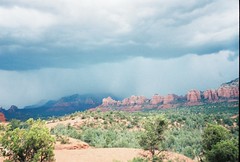
Sedona Arizona with Rein Teen Tours-4
Arizona, a beautiful place with ugly laws
Suddenly I had a lot more empathy for the illegal immigrants in America.  Although they always disgusted me, I now understand the horror of the recent anti-immigrant laws in Arizona and Alabama.  For me, at least I made the decision to come to Africa as an adult equipped to deal with the consequences.  For immigrant children who know nothing but life in America, and want to contribute, their nebulous status is not only dangerous and economically stupid, it's profoundly immoral too.  But it certainly gets worse, at least children born in the US are automatically granted citizenship, this is not true elsewhere.  In China and Switzerland, for example, you can have multiple generations of immigrants born in the country.

The point of this post is to show that, ultimately, our concepts of nationality are fundamentally arbitrary and based on the flawed rules of men not any higher morality. Congress could easily eliminate millions of criminals from the country by simply making their immigration legal. Those freshly minted Americans would have the prospects to add more to economy, serve in the military, pay into social security, and consider the police allies not enemies. It may seem outrageous today, but I see it as inevitable evolution.  Our modern ideas of nationality aren't new, the first evidence of something comprable to a passport was in the Persian empire in 450BC.

If we are indeed living in an era of globalization, it's tragically amusing that we're struggling with problems that exist largely because of concept of nationality established two and a half millenniums ago.

Jan 14, 2012

The Wedding-Industrial-Complex

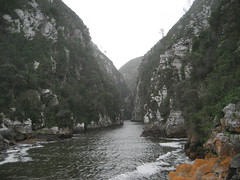
Storms River South Africa-125
Storms River, South Africa
South Africa has some of the oldest earth on earth.  Accordingly, it has some astonishing mineral reserves.  Since they started digging for it, it has been one (if not the) leading source of gold, platinum, diamonds (and much else).  This simple fact has altered a country, a race, the continent and the world for generations.  It is why South Africa has developed (and struggled) leaps and bounds beyond any other sub-saharan African country, and has since the late 1800s.  Today, the 18% of that countries economy that mining fuels keeps the country vibrant and growing even when the rest of the world economy struggles.  The simple fact that diamonds are an integral part of todays wedding ceremonies has much more to do with a guy named Cecil Rhodes than a naturally occurring stone.

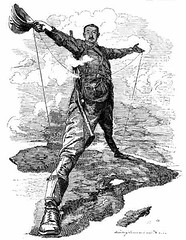
Cecil Rhodes Straddling Africa
Cecil Rhodes, and his plan
It's not only mineral riches, it's also marketing genius.  Diamonds are undeniably beautiful, but they aren't the rarest gem nor are they the hardest material.  They are an essential part of todays engagement and marriage rituals not because of something inherent, but because of a marketing campaign from the 1930s. But the story starts well before that, with Cecil Rhodes a colonial leader of a huge swathes of southern Africa.  He got his start in South Africa, and ultimately bought out the De Beers family farm and used that to secure the majority control of the worlds diamond output.  He was able to pull off this coup because his domain had the vast majority of the worlds diamonds.  He found that by carefully controlling the worlds supply he could set the price for a diamond to whatever he wanted.

After his death, the De Beers diamond company had a near worldwide monopoly of a gemstone that the world cared less and less about (in 1932 worldwide diamond sales were about $100,000.)  So, one day in the 1930s, they hired a firm called NW Ayers in the US to see what could be done.  They tried to rescue a fading concept, the 'diamond engagement ring' through clever product placement.  By 1979 the the worldwide diamond market was worth $2.1 Billion.  Specifics are difficult to find, but in 2005 the worlds output of diamonds were worth  $13.4 Billion.  More than 80% of American engagement rings have a diamond, at an average cost of about $3,200.

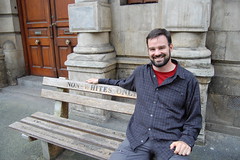
Cape Town South Africa-513
Me, breaking the (Apartheid) law
That campaign has had an unbelievable impact well beyond convincing people what stone engaged women need to wear.  It changed the economy and power base of sub saharan-Africa.  I won't exaggerate a point, but there is a reason people call them blood diamonds.  They've literally held up apartheid regimes, finance civil wars, and make a lot of beautiful people glitter.

That's only one part of what has become an astonishingly lucrative industry.  What I now like to call, 'the Wedding-Industrial-Complex' has taken DeBeers lead and used clever marketing to convince people that an average American couple needs to spend an average of over $26,000 on a single day.  There is nothing wrong with that, and I'm grateful that I've been invited to some truly remarkable weddings.  At the end of the day, it's a couples decision and whatever it becomes should be considered a generous gift to the friends and family that they invite.  But, when Erin and I talk about it, we found that even if we could afford it, it doesn't fit with our quirky priorities. We can think of other things we'd prefer to spend that kind of money on.  That could be a year-long international adventure travel honeymoon, clean drinking water for about a thousand people that don't have it, or sending 650 poor kids to the schools Erin is developing for a year.

Antananarivo-123
Erin in 'Tano
It's right about here that this whole story collapses into something a lot more personal.  People have every right to have any wedding they want, and I've long known that I'm peculiar because many of my priorities don't align with much of the society I grew up in.  What I find remarkable is, I've been fortunate enough to meet another person who shares my peculiar perspective. I love Erin, and have gotten to a point where I can't really imagine my life without her.  I wanted to ask her to marry me, but was stuck.  I don't want to be that guy so obsessed by history, politics and being manipulated by marketing that I can't let true emotions show.  Unfortunately, I didn't know if I had it in me to buy a diamond.

I asked Erin to marry me in Antananarivo, Madagascar.  I'd been thinking about it for a long time, but it wasn't until we were lost in a conversation about how we both wanted to live an 'exceptional life' that I realized that I didn't need or want to wait any more.  The next morning, we got up early and went shopping for rings in the jewelry district.  I started the day by asking her to choose any ring she wanted, quite literally, and without any caveats.  We looked at thousands of rings.  Most of them, obviously, were diamonds.

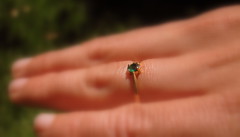
For her engagement ring, Erin chose an Emerald.
Erins Ring

Sep 28, 2010

Arrival and an Alarming Actual Allegory

Our arrival to Tanzania was, how shall I put it, dramatic.

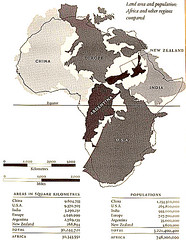
Scale of Africa
Africa is enormous!
Initially Erin and I planned to make the trek from South Africa overland.  Looking at a world map this appeared to be approximately the same distance as Colorado to NY.  I've driven that a number of a times in a little over a day, so three weeks seemed like plenty of time. I knew it wasn't precise, projecting a globe onto a 2d map skews the size of continents.  Not to mention that the US highway system has a reputation of being a little bit easier to navigate than crossing countries in sub-Saharan Africa.

Before we made it to Africa, however, I found this intriguing map in a history book (the exceptional Africa: A Biography of a Continent by John Reader.) I knew Africa was big, but had no concept that you could comfortably fit India, China, the continental US, Europe, Argentina and New Zealand inside the continent.  In reality, a direct route from Cape Town to Iringa would be farther than going from NY to California.  Not only that, but the most direct route (on sketchy roads) would send us through the painfully war torn Democratic Republic of Congo.  In other words, we decided to fly instead.

When we arrived at the airport in Dar Es Salaam, Tanzania the school thoughtfully had a man named Fouad pick us up.  He seemed to be a gentle man, very helpful and with perfect English.  As we stepped outside the airport, a mob of people rushed into the airport screaming. Puzzled, we asked what was going on... is Bono visiting Africa again?

Fouad paused and calmly stated "A man stole car.  I think they will kill him."        

Wait, what?!?  He explained that because people have little faith in their criminal system people here take justice into their own hands.  Instead of waiting for an arrest, court, and an appeal process a mob may simply stack tires around an alleged criminal and set them on fire.  Often it's a brutal but non-lethal beating, but one study found that in a five year period over 1,200 people were executed by crowds in the city of Dar Es Salaam.  Tanzanian mobs find all sorts of crimes to be capital offenses in Africa, including a shocking amount of  executions because of witchcraft (in the mobs defense, the witchcraft community is far from innocent).  Although many are probably guilty of their crimes, many are not.  Although vigilante justice makes great comic book super heroes it is deeply disturbing to see in reality.    

I find this all horrifying, but an argument could be made that as an American my perspective is hypocritical.  Although I don't support it, my country does have the death penalty.  Furthermore, it wasn't until 1968 that the US got serious about ending the practice of public lynching.  However, my problem is about more than the terror an individual would feel if chased by a mob.  It's also the symptom of a broader problem that hurts the prosperity of the country.  People take justice into their own hands because they fear, right or wrong, that if they went to the police a criminal need only pay a bribe to be set free.  Broadly perceived corruption, whether real or not, cripples society as a whole.  For example, if most people believe a small bribe will get them out of a traffic ticket there will be more bad drivers and more people die as a result of reckless driving.  The same concept applies on every level of society ranging from who gets elected to how businesses operate.  A just rule of law can make a society prosper.  

For example, despite this frightening story Tanzania is a far more peaceful place than the United States.  The Global Peace Index distills an array of complex statistics, ranging from wars to number of homicides, about a nations relationship to violence into a single number.  Tanzania is consistently ranked one of the most peaceful in Africa and far higher than the US.  However, concerns about justice and the rule of law inhibit development in a self perpetuating downward spiral whereas these particular problems aren't really a concern in the US. This real and imagined corruption, and the societal reactions to it, hold back this rich and kind society from profiting from its peaceful nature.    

Sep 6, 2010

Nonexistent Nation

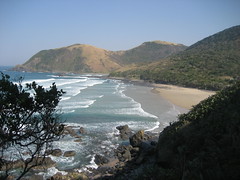
Port St Johns South Africa-166   You just can't make this stuff up.  Imagine a tiny 'nation' that tried to secede from the brutal regime of the South Africa.  And instead of waging a civil war to keep it the South African Prime Minister (and former Nazi) declared it an independent republic by referring to 'the right of every people to have full control over its own affairs' which was just a wee bit ironic considering he also staunchly also supported apartheid.
Port St Johns South Africa-46Port St Johns South Africa-125   So this newly independent state was no longer South Africa, it became the Transkei with it's own flag, government, and military for 18 years.  The only problem?  South Africa was also the only country on the planet that recognized it.  Despite their best efforts, the rest of the world (and the ANC) refused to let South Africa give it up.  It's a peculiar situation, and one that only got stranger in 1978 when the leaders of the Transkei got so frustrated with South Africa that they cut off all diplomatic ties.  Which means they cut off all relations with the only country that acknowledged their very existence. 
This all ended in 1994.  Nelson Mandela was released, apartheid was eliminated, the constitution was rewritten, and the Transkei was welcomed back into South Africa.  Which was very convenient,  because both Mandela and the next president Thabo Mbeki weren't actually from South Africa.  They were both born in the Transkei.  
Port St Johns South Africa-151

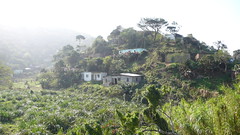
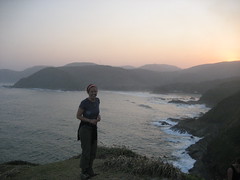
With a history like that, Erin and I couldn't resist visiting.  We navigated some long rides off the beaten path to a little coastal town called Port St Johns.  The wilderness was lush and diverse, people were friendly, laidback and integrated.  More than anything, after a long scramble along the garden route Erin and I needed a place slow down, relax and spend our days hiking and watching the waves crash onto the beach from hammocks.

Sep 1, 2010

Galavanting around the Garden route

Storms River South Africa-62
Beautiful coastal landscape, a region of vineyards renowned the world over, high end homes, strip malls, navigating as helpless pedestrians in a car culture... our trip along the Southern California African coast was fascinating and energizing.

Cape Town South Africa-513I remember learning about South Africa politics as a child.  This proud bastion of legal racism drove my late great uncle Pat crazy with frustration.  He explained the concept of Apartheid in words simple enough that I could grasp it, but never in such a way that I have ever been able to understand it.  The task of making those laws itself proves their insanity.  When creating inhuman laws for humans, the details keep compounding complexity well past the point of absurdity.  They could make a law that said blacks and whites had different legal rights ... but what about mixed-races?  Or people that weren't 'native' but also weren't exactly aryan?  Before long high courts had to develop long list of criteria, as absurd as 'if the hair is curly enough to support a pencil then they are black.'  But when that petty distinction can have a massive impact on everything about how a person lives, one has to wonder if the high court had to weigh on on whether hair straighteners were a legitimate way to 'change races.'  At some point, I've got to believe, that even the people creating the laws realized how ridiculous it had gotten.

Hermanus South Africa-24
At the time I couldn't understand why Pat thought a man thrown in prison a generation ago would still be able to change things.  But in the final years of his life Pat got to live in a world where that man, Mandela, was released and helped rebuild South African law from the ground up.  Unfortunately, there is more to ending discrimination than law and that was a reality that kept screaming out to Erin and I while we travelled along the legendary 'Garden Route.'  The major cities along the coast are immaculate, well guarded, and look like a beautiful cross between Europe, California and an army base.  Without exception people were kind, friendly and engaging but the constant reminders of economic segregation hung in the air.  Cities the hummed with activity during the day shut down at night, when the last bus to the townships took the workers back to the townships and others barricaded themselves in each night.

Buffelsbaai South Africa-1The Garden route is aptly named as it had some of the most spectacular fauna I've seen anywhere in the world.  South Africa has barely 1% of the worlds landmass, but nearly 10% of the worlds plant species.  In some parts of the Colorado Rocky Mountains you can hike all day and see only one or two species of trees.  In South Africa, its almost impossible to open your eyes without seeing a dozen.  The topography itself is magical, we sat on top of a cliff and watched surfers and a couple whales play in the bay for over an hour.  We camped on empty beaches that looked like an artists rendering of 'the ideal beach.'  We saw dozens of different types of birds on long hikes out of the back door of our 18th century Dutch farmhouse.

Storms River South Africa-85
It was a remarkable and worthwhile trek through half a dozen destinations, but halfway up the coast both Erin and I were craving something a little more 'cultural.'  We'd heard legends about a formerly independent nation hidden inside of South Africa that only South Africa recognized.  It sounded like a fascinating place.  It was far poorer than it's "neighboring," country but also without the painful history of Apartheid.  But that is a story for another blog post....